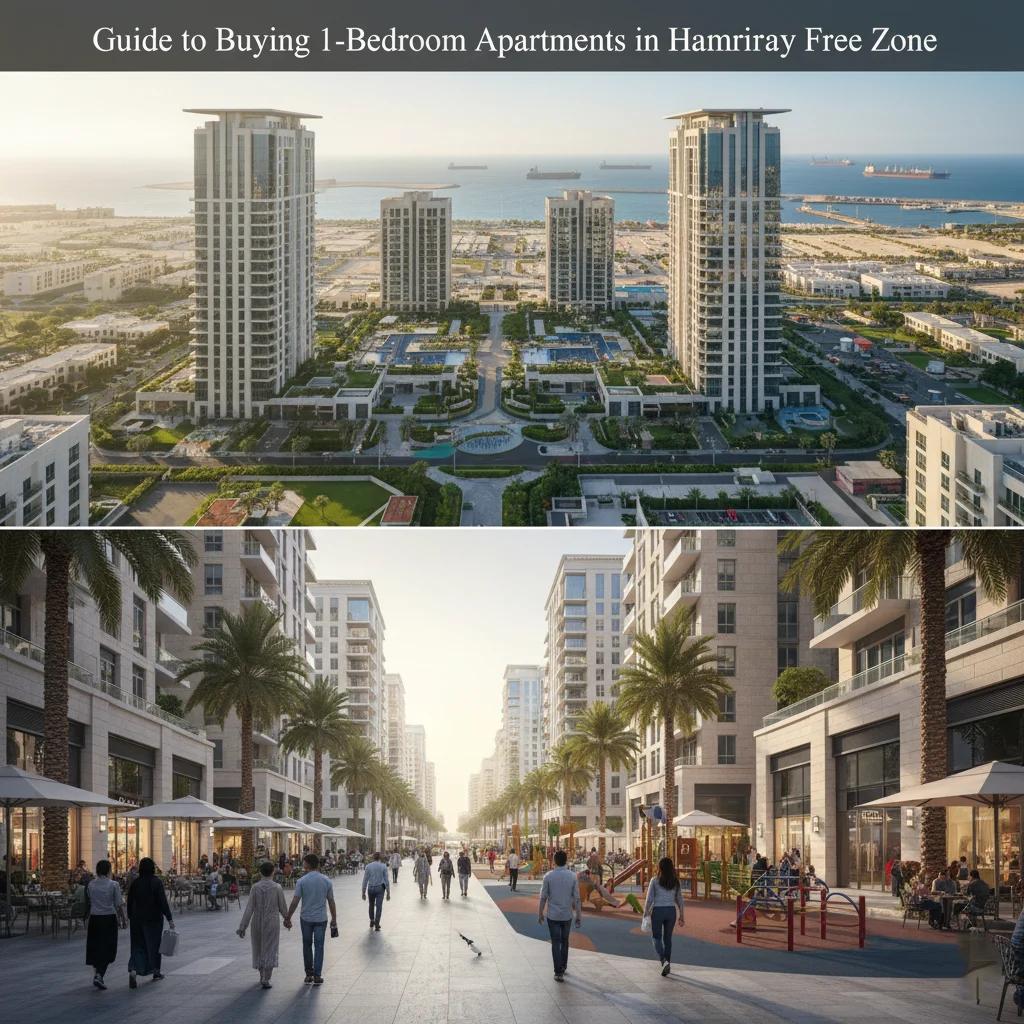
Guide to Buying 1-Bedroom Apartments in Hamriyah Free Zone
If you’ve been keeping an eye on Sharjah property lately, you’ll have noticed a surge of interest in one thing: 1-bedroom apartments in Hamriyah Free Zone. This is no accident — there are legal updates, market trends, and investor appetite all coming together to make this a hot topic. Let’s dig into what’s new, why it matters, how buying works, and what lessons you as a buyer or investor should take away.
What’s Driving the Buzz: Sharjah’s Real Estate Boom & Foreign Ownership Changes
The property market in Sharjah has grown dramatically in the first half of 2025, a shift that is influencing demand for smaller, more affordable units like 1-bedroom apartments in areas such as Hamriyah Free Zone. Sharjah Real Estate deals surged by 40%, reaching USD 3.3 billion in H1 2025. Also, laws have been updated to allow more freehold ownership by foreigners in Sharjah, expanding the zones in which non-residents or expats can buy. When property deals increase sharply, it usually means both supply and demand are shifting. Legal reforms (easier ownership) open up markets to a wider audience. Meanwhile, 1-bedroom apartments are typically among the most accessible price-wise, so they become highly attractive in times of strong market momentum. The free ownership laws mean buyers who might have been restricted before can now seriously consider investing here.
What Prices & Availability Look Like Now
Current listings show that 1-bedroom apartments in Hamriyah Free Zone are relatively affordable compared to larger units, but availability is limited and prices vary significantly based on location and amenities.On real estate platforms, some 1-bedroom units near Hamriyah Free Zone show asking prices around AED 450,000 to AED 540,000 for smaller or modest units. Meanwhile, the average price of all apartments in the area is about AED 529,925. What this means is that for middle-income buyers or first-time buyers, these 1-bedroom apartments offer a realistic option — not luxury, but functional and with potential. The price variation mostly reflects whether the apartment is ready vs off-plan, sea view or inland, finishing quality, and proximity to infrastructure. The fact that average apartment price is close to some 1-bedroom asking prices suggests some units are “on the cheaper end” of the spectrum. Availability being somewhat sparse makes it more competitive, which can push prices up.
How Legal & Ownership Rules Are Shifting: What Buyers Need to Know
Recent legal reforms in Sharjah have opened new opportunities for foreigners and clarified ownership rights in many areas, making purchases in Hamriyah Free Zone far more straightforward. Under Sharjah’s updated property laws, expats are now allowed to buy freehold property in specific designated zones. These changes also bring clearer contracts, registration mechanisms, and defined rights for investors. Freehold ownership means full ownership of the property and land (in designated areas), as opposed to leasehold (where ownership rights expire after a term). For many international buyers, freehold is more attractive and gives more security. Also, clearer legal frameworks reduce risk — fewer surprises about hidden fees, or constraints on resale or use. For the Hamriyah area, this shift means those eyeing a small apartment can more confidently commit knowing the legal context is more stable.
Benefits vs Risks: What Makes Hamriyah Free Zone Special and What to Watch Out For
Hamriyah Free Zone offers unique benefits for buyers of 1-bedroom apartments — proximity to business hubs, modern infrastructure, and cost advantage — but also comes with specific risks that require careful evaluation. Hamriyah is home to over 6,500 companies from 160+ countries, indicating strong industrial and business activity. The neighborhood has coastal access, recreational areas, and nearby schools. On the flip side, residential supply is relatively limited, and industrial zones nearby may impact noise, traffic, or environmental quality. For many buyers, especially those who work in or near HFZ, the industrial and business activity means convenience and reduced commute time. Coastal views, amenity access, schools, shopping make living there viable. The cost advantage arises because Hamriyah tends to be less expensive than the most central Sharjah or Dubai areas yet offers many of the same benefits. But, the industrial component also brings downsides: noise, pollution, busy traffic, perhaps less green space depending on exact location. Also, being limited supply means potential scarcity, higher demand, and possibly less negotiating room or higher premiums.
The Science & Strategy Behind Why Small Units Are in Demand
The demand for smaller units (1-bedroom apartments) in Hamriyah is rooted in economic, demographic, and urban planning “science” — and strategic real estate behavior.
The sharp growth in real-estate transactions in Sharjah (40% in H1 2025) shows that many buyers are entering or re-entering the market. Also, Sharjah’s cost-of-living advantage relative to neighbouring Dubai, plus its growing infrastructure, makes smaller, cost-efficient units more appealing. Legal changes opening freehold for expats contribute significantly to demand. From a supply and demand model: as buying becomes more accessible (legal clarity, foreign rights), more people enter the market seeking affordable housing. Demographically, younger buyers or small households (singles, couples) prefer smaller units. Urban planning shows that areas near economic nodes (business zones, free zones) attract people who want minimal commute. Also, investors often prefer smaller units because they cost less, are easier to rent out, and have lower upkeep. So, all these factors converge to push demand upward for small, well-located apartments.
How Buying 1-Bedroom Apartments in Hamriyah Free Zone Works in Practice
If you decide to go ahead and buy a 1-bedroom in Hamriyah Free Zone, there are process steps and key checks that will make or break whether it turns into a good investment (or good home). Real estate listings show both off-plan and ready-to-move-in units are offered; asking prices vary accordingly. Legal guides say freehold ownership, registration, checking developer credibility, hidden costs (service/maintenance) are central. You’ll need to check whether the apartment is freehold, whether the title is clear, whether you are buying off-plan or ready; both have pros and cons (off-plan often cheaper, but risk of delay or changes; ready gives you immediate use but may cost more). Also, check the service fees, post-handover maintenance, quality of structure, finishing, and proximity to amenities like schools, shops, public transport. Developer reputation matters: delivery track record, warranty, transparency. Also accounting for resale and rental potential: if many similar units are being built, oversupply could hurt price growth or rental yield.
Why This Matters: For Buyers, Investors, and Urban Growth
The significance of this trend (1-bedrooms in Hamriyah Free Zone) goes beyond individual deals—it reflects shifts in urban growth, affordability, and investment patterns in the UAE. Sharjah properties are seeing increasing transactions and foreign investment. Foreigners being able to own freehold in designated zones is a policy shift implicating long-term planning and capital flows. Listings show 1-bedroom apartments being priced thoughtfully to capture middle-income or new-market entrants. This is important because affordable housing is a global challenge, especially in fast-growing cities. As land and infrastructure costs rise, smaller units than previously popular become more essential. Urban planners and real-estate markets must adapt. For the UAE, where a large portion of residents and workers are expatriates or younger households, providing legal avenues and realistic options for owning property (even small units) increases stability, investment, and quality of life. Investors see opportunity; the economy benefits when more people can afford housing closer to where they work; infrastructure around these areas gets more investment.
Lessons & Tips: What to Learn from the Guide & Recent Developments
From the recent news and the guide, there are concrete lessons that buyers and investors should internalize to make smart choices. Some lessons reflected in data are: know your ownership type (freehold/leasehold); compare off-plan vs ready; check total cost, not just purchase price; think about location relative to amenities and industrial zones; evaluate likelihood of rental demand or resale. The guide you shared emphasizes many of these. Listings show few units, so acting fast is often important. What that means is you should come to any purchase with clarity: budget, priorities (price vs amenities, view vs distance, immediate vs long-term). Because supply is limited, and because legal changes are new, things can move quickly — prices can shift, competition increase. Also, you want to avoid surprises: hidden fees, delayed completion, mismatch between what’s promised and what you get (finishing, fixtures, services).
Conclusion
If you ask me: yes — it’s a strong option, especially if you’re a first-time buyer, an investor looking for affordable entry, or someone who values proximity to business zones and is okay with trade-offs. The reforms enabling freehold ownership, the surge in real-estate deal volume, and the relatively accessible price for 1-bedroom units all support this being a “sweet spot.” But approach with your eyes open: do your homework, compare options, check developer, check legal status, inspect everything. For many, this might be the moment where “owning in Sharjah” becomes not just a dream, but a realistic, smart choice.